Supercapacitor Activated Carbon Breakthroughs – Powering the Green Energy Transition
From Coconut Shells to Supercapacitors
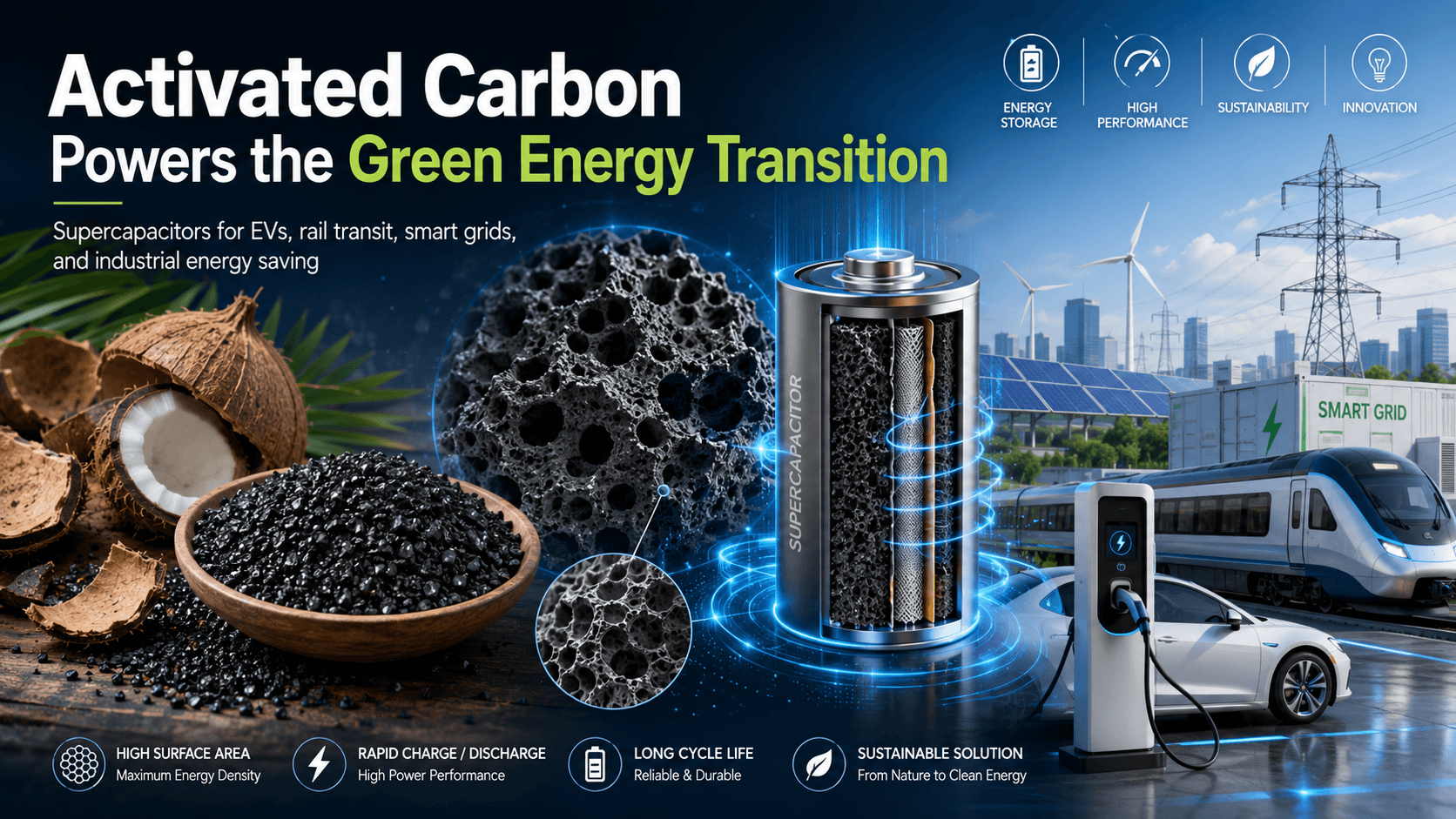
When most people think about activated carbon, they imagine water filters or air purifiers. But there’s a whole other world where activated carbon is playing a starring role: energy storage.
Supercapacitors are increasingly used in electric vehicles, rail transit braking energy recovery, smart grid frequency regulation, and industrial energy conservation. And at the heart of every supercapacitor is a simple but critical material – activated carbon. The performance of the carbon directly determines the device’s capacity and lifespan.
What’s Happening in 2026
The research community has been busy. A breakthrough study published earlier this year established clear relationships between activated carbon properties and supercapacitor device performance, bridging the critical gap between material-level research and practical device development.
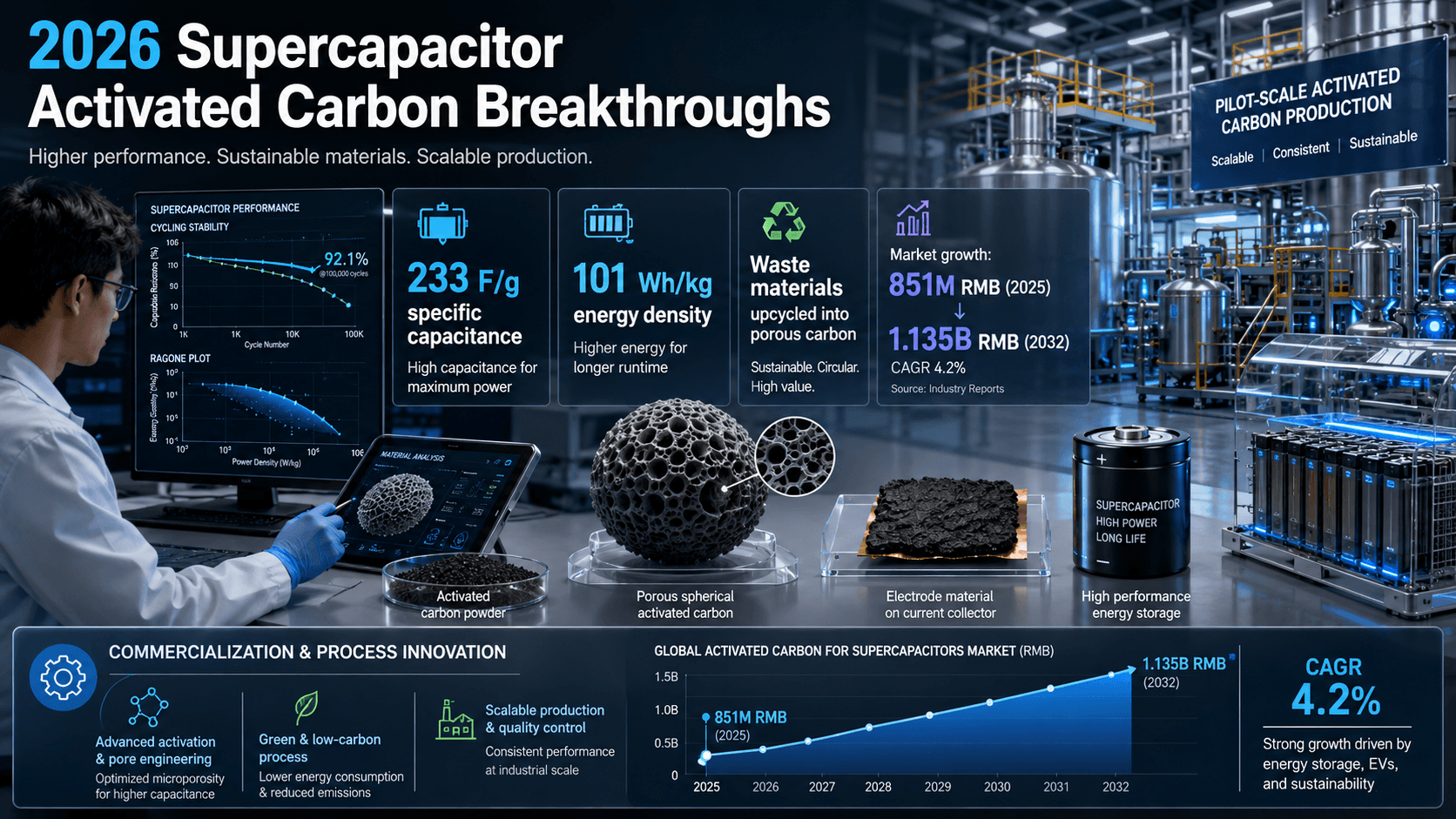
Researchers have also been exploring alternative precursors. One study demonstrated that soybean curd residue can be used as a green precursor for nitrogen and phosphorus co-doped activated carbon supercapacitor electrodes, achieving a superior energy density of 101 Wh/kg. Another team successfully upcycled waste cardboard into graphitic porous carbon for supercapacitor electrodes.
Perhaps most impressively, a study published in July 2026 showed that through a simple nitric acid hydrothermal treatment, commercial activated carbon could deliver a remarkable specific capacitance of 233 F/g – a 3.5-fold enhancement over pristine carbon.
The Commercial Impact
These aren’t just academic exercises. The global spherical activated carbon market was valued at approximately 851 million RMB in 2025 and is expected to reach 1.135 billion RMB by 2032, growing at a CAGR of 4.2%.
Meanwhile, China’s Sinopec was recently granted a patent for an alkali activation method for activated carbon production, solving the粘壁 (wall sticking) and potassium explosion risks that have historically plagued this production method. This kind of process innovation is exactly what’s needed to bring laboratory breakthroughs to commercial scale.
What This Means for the Industry
The demand for high-performance activated carbon in energy storage applications is only going to grow. As electric vehicle adoption accelerates and renewable energy storage becomes more critical, supercapacitors – and the activated carbon they depend on – will be essential.
For activated carbon manufacturers, this represents a significant opportunity. But it also requires a shift in mindset. The market is moving from commodity carbon supply toward application-specific adsorption solutions. Buyers are increasingly evaluating performance metrics like specific surface area, pore size distribution, and electrochemical performance rather than just price per kilogram.
The companies that invest in R&D and develop high-performance grades for energy storage applications will be the ones that capture this growing market. The rest? They’ll be left competing on price in an increasingly crowded commodity space.
Published by zhengzhou jinmai – committed to innovation in activated carbon technology.